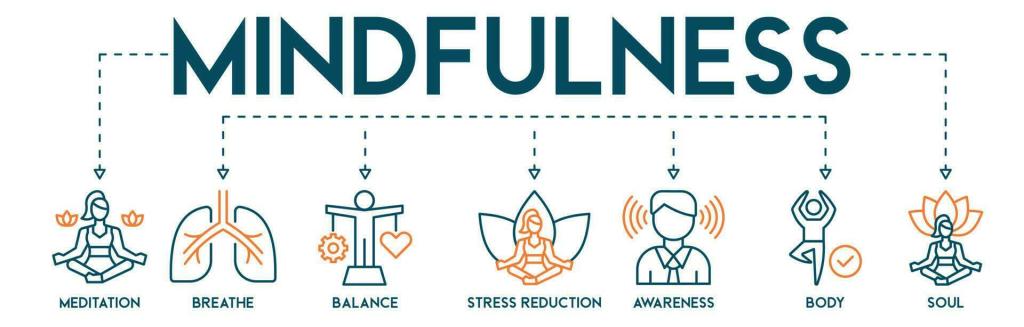

Mindfulness is the ability to get out of our own head and notice that which is around us. The dictionary definition is: a mental state achieved by focusing one’s awareness on the present moment, while calmly acknowledging and accepting one’s feelings, thoughts, and bodily sensations, used as a therapeutic technique.
This can be very useful for people who are feeling caught up in their own mind or feel stuck with their negative thoughts. When we force our attention out of our head and bring it to that around us, it prevents our mind from ruminating on what can be negative thinking. This is not something that many of us do naturally, so it requires some training. I always tell people to start simple, start the habit of looking at your surroundings and noticing what is available in the now. I encourage you to when you go into a new room, look for ten different colors. This seems very simple and maybe even pointless but what it does is train you to become accustomed to noticing what is around you when you first get to a new place. This will seem awkward at first and take quite a bit of reminding yourself before it will become a habit, but once it does you know you are ready for the next step of mindfulness.
What are the benefits of meditation?
Meditation has been studied in many clinical trials. The overall evidence supports the effectiveness of meditation for various conditions, including:
Stress
Anxiety
Pain
Depression
Insomnia
High blood pressure (hypertension)
Preliminary research indicates that meditation can also help people with asthma and fibromyalgia.
Meditation can help you experience thoughts and emotions with greater balance and acceptance. Meditation also has been shown to:
Improve attention
Decrease job burnout
Improve sleep
Improve diabetes control
What are some examples of mindfulness exercises?
There are many simple ways to practice mindfulness. Some examples include:
Pay attention. It’s hard to slow down and notice things in a busy world. Try to take the time to experience your environment with all of your senses — touch, sound, sight, smell and taste. For example, when you eat a favorite food, take the time to smell, taste and truly enjoy it.
Live in the moment. Try to intentionally bring an open, accepting and discerning attention to everything you do. Find joy in simple pleasures.
Accept yourself. Treat yourself the way you would treat a good friend.
Focus on your breathing. When you have negative thoughts, try to sit down, take a deep breath and close your eyes. Focus on your breath as it moves in and out of your body. Sitting and breathing for even just a minute can help.
You can also try more structured mindfulness exercises, such as:
Body scan meditation. Lie on your back with your legs extended and arms at your sides, palms facing up. Focus your attention slowly and deliberately on each part of your body, in order, from toe to head or head to toe. Be aware of any sensations, emotions or thoughts associated with each part of your body.
Sitting meditation. Sit comfortably with your back straight, feet flat on the floor and hands in your lap. Breathing through your nose, focus on your breath moving in and out of your body. If physical sensations or thoughts interrupt your meditation, note the experience and then return your focus to your breath.
Walking meditation. Find a quiet place 10 to 20 feet in length, and begin to walk slowly. Focus on the experience of walking, being aware of the sensations of standing and the subtle movements that keep your balance. When you reach the end of your path, turn and continue walking, maintaining awareness of your sensations.
When and how often should I practice mindfulness exercises?
It depends on what kind of mindfulness exercise you plan to do.
Simple mindfulness exercises can be practiced anywhere and anytime. Research indicates that engaging your senses outdoors is especially beneficial.
For more structured mindfulness exercises, such as body scan meditation or sitting meditation, you’ll need to set aside time when you can be in a quiet place without distractions or interruptions. You might choose to practice this type of exercise early in the morning before you begin your daily routine.
Aim to practice mindfulness every day for about six months. Over time, you might find that mindfulness becomes effortless. Think of it as a commitment to reconnecting with and nurturing yourself.
1. The Food Exercise
This is a great introductory exercise for beginners to start practicing mindfulness since it can be attempted by anyone with any kind of food (although one with an interesting or unusual texture, smell, or taste is best).
In this exercise, the facilitator provides participants with chocolate and asks that they pretend they have never seen a chocolate before. The facilitator then asks them to pay careful attention to:
- The way the raisin looks;
- How it feels;
- How their skin responds to its manipulation;
- Its smell;
- Its taste.
Focusing on the single object of the raisin is meant to bring the participant’s mind to the present, to what is right in front of them. We may be used to raisins, and not used to taking time to actually notice them.
“By focusing on the raisin in their hand and making a point to notice everything about it, they are unlikely to be expending energy, time, and attention on worrying or ruminating about other parts of their lives.”
When you follow these instructions and take notice, it is much easier to focus on what is in front of you. If your mind does wander, that is natural too. Gently guide it back to the exercise.
2. The Body Scan
Another popular exercise for practitioners of mindfulness is called the Body Scan. It requires very little in the way of props or tools, and it is also easily accessible for most beginners.
Would you like to follow a Body Scan right now? Try this 30 minute guided narrative by expert and founder of Mindfulness-Based Stress Reduction Jon Kabat Zinn:
- Step 1: the Body Scan begins with the participants lying on their backs with their palms facing up and their feet falling slightly apart. This exercise can also be done sitting on a comfortable chair with feet resting on the floor;
- Step 2: the facilitator then asks the participants to lie very still for the duration of the exercise, and move with awareness if it becomes necessary to adjust their position;
- Step 3: next, the facilitator begins guiding the Body Scan. Participants begin by bringing awareness to the breath, noticing the rhythm, the experience of breathing in and expelling out. The facilitator explains that nobody should try to change the way they are breathing but rather just hold gentle awareness on the breath;
- Step 4: next, the facilitator guides attention to the body: how it feels, the texture of clothing against the skin, the contours of the surface on which the body is resting, the temperature of the body and the environment;
- Step 5: the facilitator guides awareness to the parts of the body that are tingling, sore, or feeling particularly heavy or light, s/he asks the participants to note any areas of their body where they don’t feel any sensations at all or are hypersensitive.
A typical Body Scan runs through each part of the body, paying special attention to the way each area feels. The scan usually moves systematically through the body, e.g. starting at the feet and moving upwards as follows:
- Toes of both feet;
- The rest of the feet (top, bottom, ankle);
- Lower legs;
- Knees;
- Thighs;
- Pelvic region (buttocks, tailbone, pelvic bone, genitals);
- Abdomen;
- Chest;
- Lower back;
- Upper back (back ribs & shoulder blades);
- Hands (fingers, palms, backs, wrists);
- Arms (lower, elbows, upper);
- Neck;
- Face and head (jaw, mouth, nose, cheeks, ears, eyes, forehead, scalp, back&top of the head);
- The “blowhole” (Fleming & Kocovski, 2007).
After the Body Scan is complete and the participants feel ready to come back to the room, they can slowly open their eyes and move naturally to a comfortable sitting position.
Now that you have a firmer understanding of the Body Scan, check out our mindful body scan script which will help you facilitate this exercise for others within a group setting.
3. Mindful Seeing

The activity of Mindful Seeing may be helpful to anyone who identifies with this.
It is a simple exercise, requiring only a window with some kind of a view. The facilitator guides the group following these steps:
- Step 1: find a space at a window where there are sights to be seen outside;
- Step 2: look at everything there is to see. Avoid labeling and categorizing what you see outside the window; instead of thinking “bird” or “stop sign,” try to notice the colors, the patterns, or the textures;
- Step 3: pay attention to the movement of the grass or leaves in the breeze. Notice the many different shapes present in this small segment of the world you can see. Try to see the world outside the window from the perspective of someone unfamiliar with these sights;
- Step 4: be observant, but not critical. Be aware, but not fixated;
- Step 5: if you become distracted, gently pull your mind away from those thoughts and notice a color or shape again to put you back in the right frame of mind.
There’s an extensive group treatment plan by Fleming and Kocovski’s (2007) that offers a glimpse into how to use mindfulness in any kind of group session and provides detailed worksheets, exercises, and handouts which can provide inspiration and guidance for your group facilitation.
4. Mindful Listening
This last activity is extracted from the Positive Psychology Toolkit and introduces mindful listening as a group exercise.
Mindful listening is an important skill and can be a great group mindfulness exercise. In general, people thrive when they feel fully “heard” and “seen,” and mindful listening offers a break from focusing on the self or our own response.
Instead, this form of listening can create an inner stillness where both parties feel free of preconceptions or judgments, and the listener is not distracted by inner chatter whilst learning valuable positive communication skills.
The Mindful Listening exercise involves these steps:
- Step 1: invite participants to think of one thing they are stressed about and one thing they look forward to;
- Step 2: once everyone is finished, each participant takes their turn in sharing their story with the group;
- Step 3: encourage each participant to direct attention to how it feels to speak, how it feels to talk about something stressful as well as how it feels to share something positive;
- Step 4: participants are instructed to observe their own thoughts, feelings, and body sensations both when talking and when listening;
- Step 5: after each participant has shared, you can break into small groups and answer the questions below. Next, regroup and have a discussion and debrief with the following questions.
Those questions are:
- How did you feel when speaking during the exercise?
- How did you feel when listening during the exercise?
- Did you notice any mind-wandering?
- If so, what was the distraction?
- What helped you to bring your attention back to the present?
- Did your mind judge while listening to others?
- If so, how did “judging” feel in the body?
- Were there times where you felt empathy?
- If so, how did this feel in the body?
- How did your body feel right before speaking?
- How did your body feel right after speaking?
- What are you feeling right now?
- What would happen if you practiced mindful listening with each person that you spoke with?
- Do you think mindful listening would change the way you interact and relate with others?
- How would it feel if you set the intention to pay attention with curiosity, kindness, and acceptance to everything you said and everything you listened to?
In addition to the group activities here, you may also be interested in trying gentle yoga or Qigong, both of which involve a deliberate posture, purposeful breath, and an emphasis on awareness. Both of these activities have provided evidence for the benefits of mindfulness (Newsome, Waldo, & Gruszka, 2012).
Mindful Walking
Sitting or lying still is not the only way to be mindful. If you find it difficult to remain motionless, I recommend mindful walking. While on the walk, it is important to focus your attention on one thing rather than letting your mind wander. There are hundreds of things to direct your attention to when walking outside. Focus your attention by:
- Listening to: the crunch of dry leaves underfoot; your heel striking the pavement; birds singing; breeze rustling the trees
- Feeling: cool air against any bare skin; warm sun on your face, a breeze through your hair; your clothes against your body
- Smelling: fresh air; flowers; trees; even unpleasant smells can help you be mindful
- Looking: at the brilliant colors of a sunrise or sunset; depending on the season, colorful flowers, the green of grass, or the myriad of colorful fall leaves.
 ABC&PS
What are your thoughts about this?